Core Web Vitals have become a critical ranking factor in Google Search, directly influencing user experience, engagement, and SEO performance. Websites that load slowly, shift unexpectedly, or respond poorly to user input often struggle to rank—even if their content is excellent.
One of the most effective ways to improve Core Web Vitals is by using static websites. By eliminating server-side processing and delivering pre-built files, static sites consistently outperform traditional dynamic websites across all major performance metrics.
In this article, we’ll explore what Core Web Vitals are, why they matter, and how static websites significantly improve each one.
What Are Core Web Vitals?
Core Web Vitals are a set of user-centric performance metrics defined by Google to measure real-world page experience. They focus on three key aspects:
- Largest Contentful Paint (LCP) – loading performance
- Interaction to Next Paint (INP) – interactivity and responsiveness
- Cumulative Layout Shift (CLS) – visual stability
Google uses these metrics to evaluate how users perceive a website—not just how fast it looks on paper.
Why Core Web Vitals Matter for SEO and UX
Strong Core Web Vitals result in:
- Better search engine rankings
- Lower bounce rates
- Higher engagement and conversions
- Improved mobile performance
Poor scores, on the other hand, signal friction and frustration—especially on slower networks or mobile devices.
What Is a Static Website?
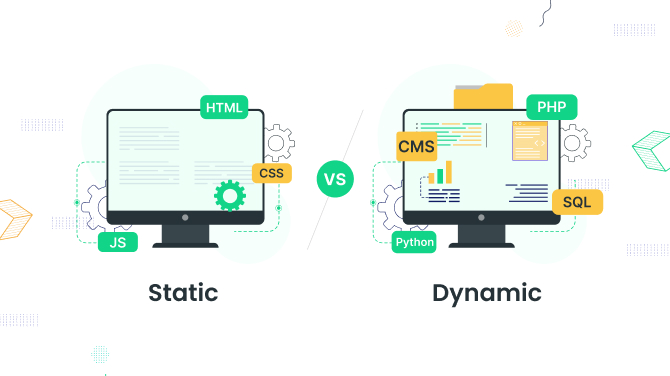
A static website is built from pre-rendered HTML, CSS, and JavaScript files. When a visitor requests a page, the server immediately serves the file without executing backend code or querying a database.
This contrasts with dynamic sites, where every request triggers:
- PHP or backend execution
- Database queries
- Template rendering
Static delivery removes these bottlenecks entirely.
How Static Websites Improve Largest Contentful Paint (LCP)
Understanding LCP
LCP measures how long it takes for the largest visible element—usually a hero image or main heading—to load.
Google recommends:
- LCP ≤ 2.5 seconds
Why Static Sites Excel at LCP
1. Faster Time to First Byte (TTFB)
Static files are served instantly from a CDN edge node, dramatically reducing TTFB. No server processing means faster initial responses.
2. Pre-rendered HTML
The browser receives fully formed HTML immediately, allowing it to start rendering content without delay.
3. CDN-Optimized Delivery
Static sites are typically served from global CDNs, reducing latency regardless of visitor location.
Result: LCP elements load sooner and more reliably.
How Static Websites Improve Interaction to Next Paint (INP)
Understanding INP
INP measures how quickly a site responds to user interactions like clicks, taps, or keyboard input.
Google recommends:
- INP ≤ 200 milliseconds
Static Advantage for Interactivity
1. Minimal JavaScript Overhead
Static sites often use less JavaScript, reducing main-thread blocking and improving responsiveness.
2. No Backend Dependency
User interactions don’t trigger server calls or backend logic, ensuring immediate responses.
3. Cleaner Frontend Architecture
Static setups encourage lean, performance-first design patterns.
Result: Faster interaction handling and smoother user experiences.
How Static Websites Improve Cumulative Layout Shift (CLS)
Understanding CLS
CLS measures how much content unexpectedly shifts while the page loads.
Google recommends:
- CLS ≤ 0.1
Why Static Sites Reduce Layout Shifts
1. Stable HTML Structure
Static HTML is fully defined at load time, minimizing late-loading elements.
2. Predictable Asset Loading
Images, fonts, and embeds are often pre-sized or optimized in advance.
3. Reduced Third-Party Scripts
Static sites typically rely on fewer ad networks and injected scripts that cause layout shifts.
Result: Pages remain visually stable from the first paint to full load.
Additional Performance Benefits of Static Websites
Beyond Core Web Vitals, static websites offer:
1. Consistent Performance Under Load
Traffic spikes don’t slow down static sites, since files are cached and distributed globally.
2. Improved Mobile Experience
Static sites perform exceptionally well on low-end devices and slower connections.
3. Better Lighthouse Scores
Most static sites achieve high performance scores with minimal optimization.
Static Websites and Real User Monitoring (RUM)
Core Web Vitals are based on real user data, not lab tests. Static sites perform better in the real world because:
- Less variability across devices
- Fewer server-related delays
- More consistent delivery
This leads to better scores in tools like Google Search Console and Chrome User Experience Reports.
Common Pitfalls That Can Hurt Core Web Vitals (Even on Static Sites)
Static doesn’t automatically mean perfect. Watch out for:
- Oversized images
- Unoptimized fonts
- Excessive JavaScript frameworks
- Too many third-party scripts
Performance still requires thoughtful implementation.
Best Practices to Maximize Core Web Vitals on Static Sites
To get the most out of static delivery:
- Use modern image formats and lazy loading
- Preload critical resources
- Minimize JavaScript execution
- Define image and iframe dimensions
- Serve content via a global CDN
Static architecture gives you a strong foundation—optimization completes the picture.
Static Websites vs Dynamic Websites: Core Web Vitals Comparison
| Metric | Dynamic Website | Static Website |
|---|---|---|
| LCP | Often slower | Consistently fast |
| INP | Server-dependent | Frontend-only |
| CLS | Higher risk | Lower risk |
| TTFB | Variable | Extremely low |
| Scalability | Limited | Near infinite |
Static websites are one of the most reliable ways to achieve excellent Core Web Vitals scores. By eliminating server-side bottlenecks, reducing complexity, and leveraging CDN-based delivery, static sites provide faster loading, smoother interactions, and greater visual stability.
As Google continues to prioritize user experience, investing in static architecture isn’t just a performance upgrade—it’s an SEO strategy.
If your goal is better rankings, happier users, and future-proof performance, static websites offer a clear and proven path forward.